Showing posts with label Reflection. Show all posts

Apr 6, 2009

Free Write #1 Sample Student Work

[This is a sample of one of 6th grader's first freewrites evah! Mistakes, cuteness and all :) Follow along as a first year teacher analyzes this shizz and comes up with some sort of plan to address his problems, and help make him a better writer in the last 2 months left of escuela!]

Prompt: My perfect spring break would...
My perfect spring bring would...Be in Hawaii. I would invite a bunch of friends like Carla, Iirwin, Ismeal, Gladyss etc. the weather would be nice every day no rain. I would have beach party every nite. It would be all expense paid. Oh did I mention that I would rent hawaii for a week you can stay in any hotel you want there will be skateboading surf boading. I will have free food there will scuba diving sky diving and more. I am telling you. it will be fun. There would drag racing exotic cars.
Ms. S' thoughts

the +
He's creative. He has a decent sense of capitalization, sentence structure, and punctuation. There is voice in his writing (e.g. "I am telling you. it will be fun."). He is successful in his attempts to use more complex vocabulary such as "expense" and "exotic."

the -
His sentence structure is inconsistent. Some verbs and prepositions are missing (e.g. "There would drag racing exotic cars," and, "I would have beach party every night.") Some thoughts are incomplete. Problems with misspelling some simple words (nite and skateboading - though I think "nite" is just a slang issue) and capitalizing proper nouns (hawaii).

Things I will try to address these issues:
-do mini-lesson on prepositions! show the whole class School House Rock clips online!
-do mini-lessons on spelling patterns (like -igh, their/there/they're, etc.).

Time for Goal Completion: I'm going to implement these tactics by the week of April 20-25, 2009 when we return from Spring Break (which starts on Wed. for us :).

Any one have some more tips or notice anything else that I should address in his writing?


Feb 17, 2009

small victory

***I meant to post this a long time ago, but never finished my thought. Since I'm on break and starting to evaluate myself as a teacher I thought it fitting to share a happy moment.

My students took the NY State Chemistry Regents Exam this afternoon (1/23/09). Though I'm terrified to grade the tests I am hoping for the best.

A veteran teacher keeps telling me that I should look at the progress my students have made this past semester rather than sulk about their lack of preparedness for the Regents. So when a student tells me, "Miss, I have never tried so hard on a test in my life." I cannot help but smile.

Feb 14, 2009

An Overwhelming Influx of Ideas

What sort of best practices work, which fit into my teaching, how can I adjust them to fit my teaching? Will they work for me? Some are contradictory. Teachers who do not practice what they preach.

Veterans around me sit in this auditorium and look just like me: they're bored, impatient, and would rather spend this time working in their classrooms. Our speakers up front continue on with their wordy powerpoint slides: "next slide please, blah blah blah, next slide please, blah blah blah..." Halfway conscious, I shut my laptop. Quarter conscious, I drift away.

But then something hits me, something engages me: "Foldables? A method to engage my kinesthetic learners? Hey, that's cool!" I take note. I consider ways to implement. This can work in my classroom. This can work for my kids. A new era of note-taking I must usher in.

A video on groupwork: group quizzes. What a novel idea! That can work too! Kids helping kids. My role as an effective questioner, never submitting to providing answers to theirs, but rather prod.. and prod some more.

Then a lady says "research has proven student achievement on tests raises considerably if students are hydrated." Another suggests that each teacher chooses a 'target group' of students to watch carefully and provide them special resources so THEIR cst scores can go up. But a seminar last Saturday suggests 'eff' the nclb!

As a young teacher, I'm overloaded w/ an influx of suggestions: philosophies of teaching, methods, proven data, etc. Some of it I like, some of it I don't. Some may even contradict each other. Bottom line: unlike the veteran's around me, I'm open to adapting new ideas to my craft. But I can't decide what's good and what's not!

And so goes the trial & error period of my young teaching career. Learning to teach while teaching so students can learn. Pieces slowly fall into place, but my philosophy, my methods, my views are all far from well-defined.

Feb 11, 2009

A Repost from the Beginning

It's been 19 months since I first stood in front of a classroom as a teacher. What follows is an old post from my own personal blog recounting thoughts & reflections of that very first session:

It still feels surreal to hear and see the name 'Mr. G-----' come from students and the white board. In fact, when I first introduced myself to the students on Monday, I wasn't sure if I should say my name was 'Ian' or 'Mr. G-----' so I just decided to go with 'Ian G-----'. Today, during my first real talk in front of the class... I told them they could just call me 'Mr. G' to keep it comfortable and also b/c my last name is pretty damn hard to say.

Anyway, I taught a 2 hour period of geometry today to 11th and 12th graders, many of whom failed the class in the past. I think I surprised myself a bit, surprised myself with the ability in my own self... to keep a classroom engaged for spurts at a time. Overall I think I generally did good, but there were definitely moments I could look back at and think... I could've done better there.

For example, I was going over a HW problem in the class. "Do you guys want me to go over a tougher one?" I asked. A collective "yeaaah!" came my way. I started doing out problem number 8 with really good confidence... a confidence quickly replaced by a "holy shit, I don't think I know how to do this." When my fellow fellow failed to bail me out on the board, I knew it was done. "Why the hell you givin' us problems if you can't even do em yourself!??" Damn. They're right. As a teacher, you gotta be as flawless as possible with this stuff.

From now on, I'm doing every HW I assign before handing it out.

Coming into today, I knew my main challenge would be learning the art of classroom management. And, yes, that's still a big one. I still have much much much to learn. I dream of the day I can teach an entire lesson without having to deal with student misbehavior and disruptions. But, I think the flow of the lesson went well overall.

One unforeseen challenge I see now is addressing the question: "how do you keep EVERY STUDENT engaged the ENTIRE TIME? And, how do you check (how do you know!?) if EVERY STUDENT is engaged the ENTIRE TIME?" I saw this a lot today, as I went over the 3 new triangle similarity conjectures. It felt like a lil more than half the class was really understanding: takin' notes, nodding their heads, participating. The rest of them seemed to just stare blankly at me and the board. And I'd do things like call on them, or ask the entire class to say/do something. They'd definitely do it, but that didn't tell me they were engaged and getting it. This is definitely a new challenge I've gotta work on.

Let's end w/ something happy. It felt really really good to see some of these kids get what I was saying. It felt really really good to walk around during independent learning time and see kids already on problem 5 (of 8) when, in the previous couple days of class, it felt like I was helping virtually every kid on the HW.

Day one done... now for the rest of my teaching life.

Less than 4 months til the completion of year two... growin' up.

Student. Teacher.

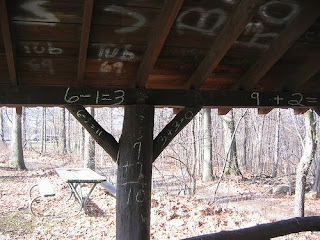
Math Fail

I'm finally on the other side of the Big Desk in a high school classroom, yet I still feel like somewhat of a fraud in including myself in this space for teachers. After day one out in the field, I went home more wide-eyed than when I first walked through the door that morning. But then again, it was hard to open my eyes at all in the wee hours of 7 in the morning. Some things about high school never change.

So, to be real, I'm not a teacher... maybe one day. For now, I'm still a student - a college student learning how to be a good teacher in an Oakland high school. Props to Mr. G for giving me this opportunity to rub elbows with high school students twice my stature and tenfold my own in life experiences.

Anyway, as would any decent college student, I scribbled a few notes about the students, the school day, and - aha! - the teacher, with the vague intention of stowing them away somewhere in case they come in handy one day. Again, no promises yet on the teacher thing. We'll see how the next semester goes. The following are a few lessons which I acquired by the end of my first day on the job.

Lesson #1: Anything can be said with a smile.

...and should be, for that matter. When teaching even the most difficult of concepts, it is helpful to continue the lesson as though there is nowhere else you'd rather be than standing right there in front of the class, lecturing about systems of equations. When answering questions, your delight will encourage students to keep 'em coming. When disciplining a student for their behavior, one subtle smile can let the class know that you still have control over the situation, that you have not lost your cool. Smile when they walk in the door. Smile when the seemingly never-ending class period is finally over. I'm telling you, your eager grin can work wonders. But then again, I suppose it depends on whether or not you have an attractive smile.

Lesson #2: Pay attention to the time.

Mr. G. has a stopwatch in his classroom that couldn't be worth more if it was made of its weight in gold. Sticking to your time schedule in the span of one class period will help ensure that those lost 10-15 minutes here and there every week won't avalanche and sneak up behind you at the end of the semester. Your day-to-day goals should be realistic, yet optimistic. When dealing with small margins of error, it's better to overestimate the reaches of your students than to underestimate.

Lesson #3: Teaching is kind of like juggling, walking the tight rope, and taming lions... all at once.

One kid is asleep in the corner, two are arguing in loud whispers over some pre-pubescent concern, one boy decided that his novel about Vampires is more interesting than the lecture, and only three students show any indication of keeping up with the lesson. Oh, and the telephone just started ringing. Welcome to a teacher's workday, where teaching the actual curriculum requires only about 15%* of your effort. While it may be impossible to cover all bases in the classroom, it's your job to try. In the end... well, I don't know. You may not win 'em all, but even the smallest of victories are worth a pat on the back.

I think I shall end there for now... That's not to say that in 6 hours of interacting with a hundred-some students and one teacher amounted to three measly paragraphs of a blog post. Stay tuned. I'll be back.

*Fun fact: 90% of generalizations are made up on the spot. Gotcha :)

Image Source: Nogwater under Creative Commons

Feb 9, 2009

The Reason Why I Edublog


I've called this edublogging not because our url contained 'edublog' but because we combine the words 'education' and 'blog' and come up with something new. Because blogging and edublogging are quite different things, at least it is for me.

This here is my space to share experiences that're likely not unique to me. In another edublog, the author had reached that all too familiar crossroads where the question "to teach or not to teach" becomes most relevant. In considering other career paths, he acknowledges that he does not necessarily seek to remain in the same field, but he does hope for a profession where purpose, passion, and experience are shared by many. Further, he notes that there might be no other.

Last year, other teachers' (whether it be with colleagues at school, classmates in credential class, or my OTF family) were my main lifeline. My space for exchanging ideas, sharing experiences, and venting. Entering the edublogosphere provided auxiliary support - a STRONG auxiliary support. Amazing how so many think thoughts, live lives, have experiences so similar to mine (I'm talking globally) - at a time I desperately sought sympathy from from friends, family, and community, this was HUGE. Amazing how so many are so willing to help; they understand me like I understand them.

I'm sure this can apply in many ways in many contexts, but with teaching, it rings so true.

And this is why I edublog, this is why this collablog exists. This is a shared experience. Through edublogging, I'm further connected to the vast community before me. In a job where the daily grind can feel so isolated, this community is what helps me breathe.

Photo credit: Amazon.com