I love teaching science to middle school because middle school kids still love science. There is still very little science-phobia in middle school, especially with 6th graders. They feed their natural curiosity by asking never-ending, out-of-the box questions and by touching, feeling, smelling, and even tasting everything. During lab demonstrations, I have students record a "Wow, Wonder, and Aha!". A "wow" is an observation of a phenomena, a "wonder" is a question about the phenomena, and an "aha!" is a "this reminds me of..." statement (in other words, a possible connection between the phenomena we witness and something we've experienced before as an attempt to understand the phenomena).
The kids are delightfully enthralled by why one yellow liquid (water and dye) and another yellow liquid (oil) react differently with a blue liquid (water and dye). They marvel at the surface tension properties of water (they were amazed at the fact that more than 30 drops of water is able to sit atop a leveled dime).
Curiosity is science, no?
I'm still feeling the waters in terms of how to teach science to 6th graders. I decided to start the course off by opening with a unit called "What is Science?" I wanted to introduce the topic of observations and wonder statements as the basis of science.
Their homework assignment during the first week was to look around their home and their neighborhood and record "data" about things that they see, hear, feel, taste, and smell. They were to then write a "wonder statement" to go with each observation. I admit, I had no idea what I was getting myself into -- I did not know that their questions would be so far-reaching.
Here are some of their data and queries:
-"I smelled my dogs poop. Why does her poop smell like that?"
-"I felt the Ipad? Why is it so hard?"
-"I hear my mom yell. What causes her to yell."
-"I tasted tacos from my mom's kitchen. What were the ingredients in the tacos?"
-"I smell garbage in my neighbor's lawn. Why does it smell like this?"
-"I feel sleepy in the morning. This makes me wonder why im sleepy."
-"I here happieness. How did I get here."
-"When did my enviorment become bad."
-"I smell smoke. How can I smell smoke but not see fire?"
-"I taste rice pudding with toasted bread. Why is rice white? Why is the bread brown? What ingridients does it have in it?"
-"I smell oil. Why do I smell oil."
-"I hear dogs barking and sometimes sounds like guns. I wonder what make those gun noises."
-"I hear the train when they go by. How is the train so loud when it goes by."
-"I can see the colesium outside. Why are the lights so bright."
-"I feel danger. When did my neighborhood become bad."
Showing posts with label Posts by Ms. April. Show all posts
Showing posts with label Posts by Ms. April. Show all posts
Sep 1, 2011

Jun 9, 2011
Compliments and Middle School Teachers
I had an evaluation meeting with my supervisor and colleague about my performance as a student teacher. One of the things said about me during the meeting was, "she has such a middle school personality."
Hopefully they meant "middle school teacher" personality and not "middle school" personality.
At any rate, that comment had me floating on Cloud 9 all day. My colleague did not say it in a particularly praising (or otherwise) manner, but I will take it as a compliment. I interpret it to mean that my ever-evolving teaching personality contains a bit of patience, strictness, wackiness, and a love for middle school students' quirkiness. Perhaps this is my interpretation of the statement because I know that I want to teach middle school students and this is is the personality type that I'm aiming for in order to teach middle school. I haven't yet had enough long streaks of teaching on my own for me to have enough of a meta-understanding of how I interact with my students or how they perceive me...
Also, this may or may not be what my colleague meant when he made that observation, but I'm willing to live with the ambiguity.
Jun 2, 2011
The Cogs and the Difference-Makers
Casual Conversations about Teaching.
That was the best that I could come up with in the moment. I quickly tried to mask my flustered lack of response by spitting out my work-in-progress philosophy of teaching to my non-teacher friend:
So Why Teach?
How many adults can say that they love the people that they work for? I don't mean the people who sign your paycheck or the people who hold your employee contract in their hands -- I mean the 25 - 120 people you see from the time you "punch in" to the time you "punch out" every weekday. I mean the people for whom you refrain from hitting your snooze button one more time each morning. I'm talking about the people who give you hell and yet count on you to be there every day. I'm talking about...
OK, OK... This is starting to sound like another stereotypical sound bite. Self-righteous proclamations by young, privileged, green teachers in urban schools are a dime a dozen nowadays, so I'll stop there.
What I wish I had told him is I don't teach to change the world, a city, a school district, or even an individual. Who am I to single-handedly climb onto soapboxes and rally the crowds with romantic notions of "change" until they start thinking like me? No, no. I cringe at the thought. This is not why I teach, nor is it why I like to teach in urban communities.
I teach because I love having dozens upon dozens of interactions in one day, sometimes even in the span of one hour. I teach because I like feeling my problem-solving brain cells buzz with each new snag or new form of an old snag. I teach because I like the "ah-hah!" reactions of students after making a new science discovery. I teach because I love watching students interact with each other and lift each other up when their friends need a boost.
The Difference-Makers.
Yes, I am merely another cog in a runaway machine, but so are politicians, administrators, standardized test-writers, good teachers, bad teachers, hardworking parents, academically-prepared students, students with learning disabilities, students of Color, White students, janitors, counselors, drop-in tutors, and college admissions officers. They all are never going to stop doing what they do despite mass confusion about best strategies towards meeting ill-defined and oftentimes conflicting end-goals so why should I? Are they making a difference? If they are not, then why do they do what they do? If they are, then what makes them so different from me that I shouldn't try to, as well?
And if I don't "make a difference" (whatever that even means anymore), screw it. I'll teach anyway. I don't have the mental capacity to foresee what my kids', the nation's, or my future holds. Hell, that's another reason to teach -- because we don't know what the future holds, because the future is not set in stone, and because we can contribute towards shaping it.
But no matter. At my immortal-minded, naïve, inexperienced age, I'm not thinking long term. I can only focus on doing my best each day, enjoying doing my best, and giving my students enough encouragement to stay in school and continue their education for themselves just a little bit longer. When my days no longer are fulfilling, I'll quit. 'Til then, I'll teach.
- - -
Besides being inspired by that conversation to write this post, I was also inspired by the passion in the form of professionalism by a local teacher and fellow alumnus of Mills College. Please read about and/or watch the video about her research through teaching when (if) you find a free moment in your chaotic end-of-the-year teaching lives.
- - -
Him: "Wow, you want to teach in New York and D.C? Those are some tough areas. You know that those districts and cities are so big that you probably aren't actually going to make a difference, right? I mean... you know that, right?"
Me: "Umm... yeah, but... it's not about that..."
That was the best that I could come up with in the moment. I quickly tried to mask my flustered lack of response by spitting out my work-in-progress philosophy of teaching to my non-teacher friend:
"It's just that... I love teaching. I don't know how else to say this without it sounding weird, but I love teaching these kids. If I had to go back and teach at (*******) again [a "picture perfect", White suburban, upperclass high school where their biggest problems were kids cheating to get high grades and substance abuse due to pressures at home to get good grades... albeit, all big problems that need to be addressed, just not my cup o' joe], I'd quit teaching and find something else to do because it was not fulfilling for me.
These kids... they make it so I can show up to work nervous, anxious, and recovering from a bad night or a bad week of teaching and completely turn my week around. Behavior and antics aside... I love my students."
So Why Teach?
How many adults can say that they love the people that they work for? I don't mean the people who sign your paycheck or the people who hold your employee contract in their hands -- I mean the 25 - 120 people you see from the time you "punch in" to the time you "punch out" every weekday. I mean the people for whom you refrain from hitting your snooze button one more time each morning. I'm talking about the people who give you hell and yet count on you to be there every day. I'm talking about...
OK, OK... This is starting to sound like another stereotypical sound bite. Self-righteous proclamations by young, privileged, green teachers in urban schools are a dime a dozen nowadays, so I'll stop there.
What I wish I had told him is I don't teach to change the world, a city, a school district, or even an individual. Who am I to single-handedly climb onto soapboxes and rally the crowds with romantic notions of "change" until they start thinking like me? No, no. I cringe at the thought. This is not why I teach, nor is it why I like to teach in urban communities.
I teach because I love having dozens upon dozens of interactions in one day, sometimes even in the span of one hour. I teach because I like feeling my problem-solving brain cells buzz with each new snag or new form of an old snag. I teach because I like the "ah-hah!" reactions of students after making a new science discovery. I teach because I love watching students interact with each other and lift each other up when their friends need a boost.
The Difference-Makers.
Yes, I am merely another cog in a runaway machine, but so are politicians, administrators, standardized test-writers, good teachers, bad teachers, hardworking parents, academically-prepared students, students with learning disabilities, students of Color, White students, janitors, counselors, drop-in tutors, and college admissions officers. They all are never going to stop doing what they do despite mass confusion about best strategies towards meeting ill-defined and oftentimes conflicting end-goals so why should I? Are they making a difference? If they are not, then why do they do what they do? If they are, then what makes them so different from me that I shouldn't try to, as well?
And if I don't "make a difference" (whatever that even means anymore), screw it. I'll teach anyway. I don't have the mental capacity to foresee what my kids', the nation's, or my future holds. Hell, that's another reason to teach -- because we don't know what the future holds, because the future is not set in stone, and because we can contribute towards shaping it.
But no matter. At my immortal-minded, naïve, inexperienced age, I'm not thinking long term. I can only focus on doing my best each day, enjoying doing my best, and giving my students enough encouragement to stay in school and continue their education for themselves just a little bit longer. When my days no longer are fulfilling, I'll quit. 'Til then, I'll teach.
- - -
Besides being inspired by that conversation to write this post, I was also inspired by the passion in the form of professionalism by a local teacher and fellow alumnus of Mills College. Please read about and/or watch the video about her research through teaching when (if) you find a free moment in your chaotic end-of-the-year teaching lives.
- - -
Apr 27, 2011
Help Wanted: How Do I Create Learning Opportunities for Students Who Need it the Most?
One problem I've been struggling with lately is that I noticed that my students can be divided up into the following student categories:
= = =
Student Type 1: I understand the material and I just got a [91-100%] on the test. I am ignoring you as you talk about ways to get help on the material.
Student Type 2: Agh!!!! I don't get it!!!!! HELP ME! I'M FAILING...AT LIFE! (*Student Type 2 comes in for extra tutoring before school, during lunch, during advisory, and after school; student also proceeds to take advantage of every extra credit opportunity and test corrections; meanwhile, their grade creeps up from a C+, B-, or B+)
Student Type 3: I got an F on this test. I am too far gone to do raise my grade. Also, before school/lunch/after school is my time, not yours.
= = =
Short of advising that I teach my students the material in such a way that they understand it the first time around (I'm working on it!), what can I do for my students who are unmotivated to put in the extra extra work that it takes to catch up and keep up with the material?
Many of these students who struggle from the beginning are already trying to cover more ground due to information gaps (e.g., some students learn how to balance chemical equations in middle school, others do not, yet all are allowed to enroll in high school chemistry). The longer that we press on in chemistry, the further they fall behind; the further they fall behind, the less motivated they are to take advantage of remedial/extra support. This, of course, leads to sinking grades which then leads to less motivation, and... yeah. You see where I'm going with this.
So how can I offer support to the students who need it most in such a way that they do not feel embarrassed to ask for help? How do we show these students that it's not hopeless and that we have not given up on them? How do I, every now and then, close my doors to the students who do come in for tutoring to get the C+ to B- grade boost so that I can give the students who are struggling the most a few moments of undivided attention?
I've tried a couple of things: I suggest to all students that they ask each other for help and that I am not the only resource in the classroom for learning science; I've tried having less drop-in tutoring and more invite-only tutoring sessions. I cannot tell if the former is working; as far as the latter, I end up getting a lot of no-shows.
I know that my question is nothing novel -- does anyone have any suggestions for me?
Mar 24, 2011
Good Day Sunshine
OK, so there is no sunshine to speak of in Berkeley, but today was a good day!
I’m glad for it, too, because yesterday was such a bad day. I was “putting out fires” for most of the period and ineffectively chastising students.
I started off yesterday’s period with a Do Now that asked students to identify reactants and products, to identify a reaction as a combustion reaction, and to predict whether the reaction requires heat or gives off heat. We then did a pre-lab as a class.
Students were bored, antsy, confused, and apathetic. As a result, they acted out. And as a result to that result, I reacted. Heck, I probably reacted because I was bored and confused.
At the end of the day, two tips that I’ve received previously from veteran teachers came to mind:
1. Science is hands-on – it’s fun! There’s no point in disciplining a class all day long if there is no science being learned or done. Once you bring out the activity materials, students will be so excited and consumed in the activity that they will not have any reason to act out.
2. Engage in the practice of “need-to-know”; that is, only give students science jargon when there is a need to know it. Meanings for new words do not stick unless appropriate context is associated with the word. For students to understand its meaning, the word needs to be meaningful to the learner. Do not “tell” students filament and stigma, rather, give them a flower to analyze and have them describe and identify its parts. Only when a student asks, “what’s this skinny part?” do you as the teacher give them the new word.
I failed in both of these arenas yesterday. I made my students sit in their desks with nothing but a pencil and paper in front of them for the entire period. Their only opportunity for engagement and interaction was when I asked students to interact with me in “teacher ask, student answer” fashion.
I knew that I needed to scrap almost everything about yesterday (except for the Do Now! I’m never getting rid of that!). I observed my colleague, Natalia, at her student teaching placement yesterday after leaving my placement and learned a lot of tricks of trade. I was very excited to implement these strategies today. Her strategies included:
- Make it so students have no excuse not to do their work. Need paper? Here ya go. Need a pencil? I’ve got plenty. Oh, you want to use pen? I’ve got that, too. Forgot your book at home? Take mine. Can’t see the board? Try on my glasses.
- If a student is off-task, rather than badgering the student with: “get to work”, “stop talking”, “turn around in your desk”, approach the students instead with: “how are you doing on your work? Do you know what you’re supposed to be doing now?” Try to identify the reason for the students' behavior rather than simply addressing the behavior.
- Congratulate students often; do not let small successes go overlooked. When a student who is habitually tardy finally arrives on time, thank the student… etc. etc.
Anyway, all that to preface why today went relatively well. For my students’ Do Now, I had them finish the procedure section of their lab report. I figure, a Do Now does not have to be a problem to solve – it can be a silent task, too. Students entered the classroom slightly confused at the change of procedure at first, but I restated and clarified the directions over and over again and wrote the directions on the board until finally, everyone knew what to do.
Two of my students, D and T, are a tricky duo. They used to act out when they were separated, so I sat them together. That worked for awhile… and then it stopped working. I tried reminding them about how I am trusting them to monitor themselves and each other, to no avail. Finally, today I pulled them outside at the beginning of class. I tried asking them if they really are mature enough to sit together, but neither boy would make eye contact with me or answer my questions. I said “fine, I’m going to step inside for a moment and leave you two to decide with each other if you need to be separated or if you can sit together without disrupting the class.” I entered the classroom and attended to the rest of the class. Before I could return outside to check on the boys, they entered the classroom calmly and returned to their seats together. They were fine for the rest of the day. I made sure to praise them both, on separate occasions, for staying on task.
Students worked with chemicals today, exploring endothermic and exothermic reactions in Ziploc bags. Since they were only working with bicarb, phenol red, and calcium chloride, I could more or less leave them to conjuring up every combination they could imagine in various amounts. They had a lot of fun and acted very orderly because we had just reviewed safety procedures when in lab (handle chemicals carefully, do not walk around the classroom holding chemicals, take turns, etc.). They got curious and asked permission to add other things in their reactions to see what would happen (i.e., a lock of hair). I made sure to have them predict outcomes before running reactions and made sure that they notices certain physical changes lest they get too distracted by other physical changes (for example, “touch the baggie! Don’t be afraid! Remember, we are experimenting with endothermic and exothermic reactions today, what should you be paying attention to?” when they became too afraid that the expanding baggie was going to explode in their hands as it filled with gas).
We were all so involved in the chemical reactions that I did not have time to hand out their exit tickets. Instead, their exit ticket was to clean up their lab stations. The classroom has never been so clean!
I even assigned homework today and was met by reactions of “oh, that’s it? We only have to do this section, that’s it?”.
I love my kids!
Mar 17, 2011
"Letter to a Young Teacher"
Yesterday was a bad teaching day on oh-so-many levels. I'm talking kids out of their seats, chasing each other, cussing each other out... Never again. Never, never again will I let things get to that level. Well, if I can help it, anyway.
I need to keep reminding myself that I can only do my best, and at that, my best is pretty good. Next year, my best will be even better, and so on. The important thing is that I need to keep showing up for the fight so that I'll have shortcomings to learn from and successes to celebrate.
My head is still above water, though, and I am trying to congratulate myself for at least that.
This blog post, written by one of my teachers and mentors, is helping me hang on to my vision despite thoughtless (and painful) side comments from others ("Still sure you want to go into teaching?"). In a letter to a disheartened young teacher, he says, in a nutshell:
We go back to work again and again for [these] goals... The joy of working with kids. The commitment to organizing and social justice. The pay is bad but, really, not that bad. One can have a decent, if modest, living doing this. And we may be scorned by idiots but we are revered by parents, communities, and students. (--Rick Ayers)
I need to keep reminding myself that I can only do my best, and at that, my best is pretty good. Next year, my best will be even better, and so on. The important thing is that I need to keep showing up for the fight so that I'll have shortcomings to learn from and successes to celebrate.
Mar 3, 2011
3-3-11
Each time that I post my mini-goal for the day, I am usually able to finish my day in a hopeful mood. So let's go.
Today, I will do a better job of setting my students up for success in their Exit Slip.
-and-
Today, I will encourage conversations about analyzing data.
= = =
I'm surprised that I escaped yesterday w/out anyone's hair catching on fire. For real. We're launching match rockets in class and students were having trouble staying clear of the runway and landing pad. Students were bouncing off the walls because they had just gotten out of an assembly, it was a minimum day, and there were big, bad high school students roaming the classroom visiting their old teacher. My kids just HAD to prove to the older kids how big and bad they could be, too. Did I mention I only had 15 minutes to teach something meaningful and catch it on video for my PACT?
Crossing my fingers, hoping that PACT graders find my students' behavior as endearing and my teaching as relentless.
Feb 14, 2011
Zoom In: Do Now
I borrowed a page out of Mr. G's book -- literally, more or less -- and made Do Now sheets for the students that they could hold on to for the week.
Until recently, I collected half sheets of Do Nows from students. I found, though, that students were getting confused about where they jotted down some of their notes or ideas because I did not give the Do Now half sheets back (shame on me). I hope that this way, with the Mon-Tues-Weds-Thurs-Fri Do Now sheet, they'll be able to track what we've covered over the past week.
Another way that I tried to improve our Do Now time is that I initialed students' sheets if they had finished/attempted the question. Even though I walked around and checked for progress before, the fact that I was now marking their papers motivated students to show me that they attempted it. I have a hunch that the students whose Do Nows were blank prior to today were attempting the problem in their head, but if they were not confident in their answer, they would not put anything down. Since I am giving credit for work shown, I get to now see students' thinking and reasoning regardless of correct answers.
Students have plenty of time to get from one class to another; as they enter our classroom, there is usually a minute or two of settling down before the bell rings. At first, I wanted for students to enter the room quietly and calmly. I'm starting to let go of that fantasy, though. The kids always file into the classroom excited about something: Valentine's day, a game that was on the night before, a project that we are doing in science, the fact that their dog just had puppies... the list goes on. They crazy. My friend gave me a nice analogy today:
"Sometimes, when I'm at home and watching TV, I put the TV on mute so that I can do something for a moment. When I'm done with whatever it was I was doing, I un-mute the TV. To my surprise, the volume is incredibly loud and blaring at me! I did not notice how loud the TV actually was until I compared it to complete silence. When students are walking into the classroom, they might be coming from a fun activity, or from the lunch room, or from the loud, crowded hallways, and they do not realize how much of that loud energy they are bringing with them into the classroom. I think that when students are in the classroom, it's important to bring the noise level down to complete silence for at least a moment; that way, students will have a frame of reference for their own volume."
I'm learning to allow students to shake off their crazies until the bell rings. Once the bell rings, I told them that that is a signal for us to be in our seats and working quietly and independently on the Do Now. It sometimes takes a moment, but I'm learning to be OK with that because the kids are 8th graders: they're silly and they're very emotional. My main focus in terms of volume now is to give kids a frame of reference of where our volume needs to start in our classroom before we can start adding volume throughout the period.
Feb 7, 2011
2-7-11
I know that "they" say not to talk over people when teaching/giving instructions, but I think I'm going to leave room for on-task chit chat. At any rate, I'm done with sucking all the fun out of 8th grade by being a police officer at the front of the room instead of a teacher.
Student today asked if I was wearing contacts. That confused me for a second because I do not own contacts. Then I realized that I forgot my teacher disguise (a pair of über weak glasses) at home. These kids don't miss a thing.
My Do Now question for the day involved the students writing down a question that they might want to pursue for their science fair project. As I walked around, I saw that students had some really exciting and creative ideas. When I asked for a share-out, though, everyone was shy/uninterested in participating. So much for that. I need to find a way to make share-outs actually important and useful. I need for them to share out so they can hear each others' ideas and so their classmates and I can give public feedback.
Jan 25, 2011
Taking Care
This semester (and forevermore), I promise to take care of my whole self, not just my teacher self.
This way, my students will have a more put-together teacher standing in front of them each day.
Jan 16, 2011
As Seen on Postsecret
 Came across this secret in this week's collection on Postsecret.
Wouldn't it be interesting to have a Postsecret: Teacher Edition?
-AA
Dec 24, 2009
My Dream
I guess I just had my first nightmare about teaching.
But who can blame me? I went with my family to my dad's office Christmas party--complete with Christmas carols, the presents game where you draw a number, pick a present, and steal gifts from each other, and "graduating college, eh? What do you plan on doing with your life?" interrogation questions.
My life? I don't know. But I plan on teaching in the near future. The following are actual quotes:
-"Oh! ...Wow. That's... a noble endeavor."
-"Teach high school? ...but why?"
-"Teach for America! I had friends that tried Teach for America! ..They had a hard time.... Yeah.. a really a hard time... uhh... good luck."
And, a quote which I overheard from halfway across the room. They were talking about the woman who sent a death threat to Michelle Obama:
-"She looks completely harmless--like a high school teacher or something... someone that no one would ever take seriously!"
= = =
In my nightmare, I dreamt that the kids tore the classroom apart, tore me apart, and then tore each other apart. Then I dreamt that I time traveled (I'm currently reading The Time Traveler's Wife), visited the me of 2009 and told myself not to ever become a teacher. And then I dreamt that I went on to teach English in Japan to a group of robotic, uniformed schoolchildren.
= ==
I know that I really want to do this. I need to keep telling myself that because it seems that teachers and non-teachers alike are quick to share words of caution. In particular, non-teachers wonder why a soon-to-be college graduate would choose teaching as their first profession, let alone a last-resort profession.
= = =
I really want to do this.
Dec 14, 2009
Showtime
I enjoy singing, but nothing gets me shakin' in my boots more than a room full of expectant audience members.
This is a list of reminders that I use when I am overcome with stage fright. Perhaps it can dually serve as a list of suggestions for nervous teachers.
- Have good posture. Give your diaphragm the space that it needs.
- Relax your shoulders and fingers.
- Don't lock your knees.
- Project your voice. Aim for the back of the room.
- Listen.
- Keep your eyes expressive.
- Breathe.
Dec 10, 2009
Feeling Green

Everyone else in the 10th grade Algebra II class seemed to have finished the math problem. They listened patiently to S, who was called upon by the teacher.
I have a bag of 3 red apples, 1 green apple, a lime, 4 tomatoes, and an orange. What is the probability that if I pull out 3 fruits, 2 of them will be green?
Finally, the teacher walked through the problem with her.
T: "How many fruits are there total? How many fruits do you want? How many green fruits are there?'S: "10...3....... 1."T: "Is there only one green fruit?"S: "Yes. An apple." *The class laughs*T: "S, what color are limes?"*"Green!" her neighbor whispers'*S: "OHH..." She proceeds to get the question correct.
As it turned out, I got the question wrong myself. I can never remember if limes are yellow or green: in my family, our citrus consist of lemons, calamansi, and dalandan. Over-sized calamansi with green insides are called limónes.
English can be tricky sometimes -- even in a math class.
Nov 12, 2009
Public Education in California

"California schools are attempting to educate the most diverse and challenging school population in the country and doing it with substantially fewer human resources than almost any other state. The state has the most students, a diverse group of students, more English learners than any other state, and substantial numbers of students from low-income backgrounds. It will also soon again face increasing enrollment. At the same time, the state has fewer school staff per pupil than all other states and spends less than the national average per pupil. " -- Comparing California (June 2008)
I need your help! ...OK, if that wasn't convincing enough for you: California needs your help!
California's public education was ranked at the beginning of this year as 49th in the nation in general public education (and even in specific education categories such as technology). Compare this to 2007, when California came in at no. 14 -- either Californians care less about education, or everyone else stepped up their game (for more disheartening news about the state of California, see here).
This may or may not be new information to you, but my close friend and I are hoping to spread this news to our community members and mobilize them to find solutions and take action. We share many experiences, ideas, and resources; we don't have all the answers, but we have the drive to seek them.
I invite you to consider the following course objective for a class that we plan to facilitate next semester:
1. What is the nature of the subject matter or content of the course?
The subjects of this course are California public education, California state government and education institutional policy, the many cultures of California, and how these three subjects work with and against each other. The explorations of this course are based on academic literature and shared experiences. The nature of this course is collaborative learning and hands-on experience/practice in the public school sector and democratic practices in city and/or state government.
2. What are the key learning outcomes?
- To experience and build strong ties with the surrounding community and community-based education organizations by means of an understanding of the solidarity and equity discourses.
- To recognize one's self agency; to become empowered and empower others in order to mobilize for equity in public education at the grassroots level.
- To develop a better understanding of alternative systems, sites, and methods of education, as well as the multiplicity of experiences within public education.
- To practice one's power in democratic processes by working towards improving education at a structural level.
- To begin personal working definitions of an "equitable public education.
For more information, please read our course syllabus.
Feedback, ideas, resources, and general support is welcome and much needed!
Img Src: Cartoon Stock
Oct 8, 2009
Another Hurdle
A new school year is in full swing. This means a slew of new experiences for even me, an undergraduate high school tutor working (for no pay) in the Bay Area.
For starters, I've gone from shadowing in an Oakland Algebra I and Geometry classroom to doing odd-jobs at a charter 8th-12th high school in Berkeley. Coincidentally, one of those odd-jobs consists of shadowing in a 10th grade Algebra II class. I feel like I've been promoted alongside Mr. G.'s students from last year.
I'll have plenty of stories to share about this charter school later.
For now, I just wanted to say that I stand before you all, absolutely humbled.
I've formally tutored for a good 5 years now. In those years, never have I written a single lesson plan. None. Nada. Zilch.
That being said, I sat down to write my very first one five hours ago. Granted, I've had a week to do this and it's been on my mind for that long... so it's kind of like I've been working on it for a week. In my head.
Now, five hours after the sitting-down part of the lesson plan-writing process, I've come up with the following:
Objective: Learn how to identify graphs of corresponding equations with rational exponents.
...yup. That's it.
And let me tell you, I've been graciously provided resource after resource -- worksheets to fill in my "Objective" and "Materials Needed" and "Students' Prior Knowledge"; instructions on the 5E Lesson Plan; an entire Algebra II student textbook; website after website of complicated (and boring) suggestions -- but I can't come up with a single, comprehensive lecture or activity.
I've taught, I've bonded with, graded, and even disciplined students. But this -- this lesson planning -- is foreign territory. I have a compass, but no map. And certainly no GPS.
Best regards to the experimental class who will be the first to experience Lesson Plan à la April.
Apr 29, 2009
CAHSEE Schmahsee.
I'm dating myself, but I was actually part of the first graduating class that the Big Guy and his constituents decided would use as Exhibit A for the California High School Exit Exam. That's the Class of 2006.
I remember leaving the test site as a 15-year-old sophomore thinking, "that's all that the state wants me to know in order to graduate?" My teachers did little to prepare us for the test because none of us really knew what to expect. Turns out, all we needed to know was 8th-grade math and reading/writing.
Fast forward five years: I'm in high school yet again, this time preparing a 10th grade algebra student, S, for her upcoming CAHSEE. By the end the class period, I remained in my seat, my head in my hands, dazed and exhausted.
I'll get back to this in a bit, but first I want to write about a talk that I attended this afternoon. It was held at UC Berkeley by a Professor Emerita of Education, Lily Wong Fillmore.
"The CAHSEE is easy," she began. "The CAHSEE is supposed to set the bottom line in order to graduate... it is comprised of two sections: language arts and math."
Easy? I spent this entire semester learning about shortcomings and unfairness of standardized testing, tutoring (and failed at tutoring) kids on standardized testing, and here, a professor stood before me saying that the CAHSEE is too easy?
She then handed out released test questions from both the CAHSEE and the state test issued to high school students in
We compared sample questions from
Basically, it boils down to this --
Regardless of where a student’s home state sets the bar, S was not able to complete or comprehend a single problem from the bank of practice questions. She was frustrated because she felt that she didn't know anything. I was frustrated because the questions were complex and multi-step, meaning although she knew enough math to get her through the first half of the problem, she did not know enough math to get her a right answer. In other cases, the math problems were too wordy; she couldn’t understand what the test was asking of her.
I felt bad for S. What was she going to do? I was pretty confident that she was going to get a big, fat zero on the test that was coming up in a few days. There wasn’t enough time to cover everything that she would need to know for the test. After she takes the test, she will forget about it and go on with schooling for the next year until it’s time to retake the very same test. Who is going to teach her eight grade math and language arts by then?
The kicker: after I took the CAHSEE back in 2004, I received a letter in the mail informing me that I did not pass the test and that I would not graduate high school until I retook and passed the exam. It turns out there was some kind of administrative mistake in the mail room, and they accidently sent that letter to me and all of my classmates.
Mar 4, 2009
You've just been schooled... son.
Mr. G. has vented to me about J's misbehavior on several occasions. When I work with J, I see a kid that knows the material. He usually does his class work, but I can't get J to do anything that he doesn’t want to do. J has a restless mouth.
As I thought over my shoulda-woulda-coulda's J tauntingly shook his wet umbrella in W's face. Teacher holds W back before W could take a swing at J. Yeah right W, would you really have taken J?
W is another story. He is also loud, disruptive, and attention-loving, but W is short. In fact, he overall looks and acts much younger than the rest of the kids in the class, even though they are all the same age. W is a nice little example of the "Napoleon complex". W has restless feet.
W looks up to J (so to speak). W only commits to good behavior when J leads by example. J is a leader. W is a follower (so much for Napoleon). Neither listen to the teacher. Both are smart students who have shown me that they can do the class work on their own. J is a bully, instigator, and sometimes a disruption in class while W is easily antagonized and always a disruption in class.
All throughout class, both W and J were being disruptive - separately.
J was sitting in a desk at the right-most column and in the middle row. He was dutifully taking notes and doing the class work, but he had a side comment for everything the teacher said. If J didn’t have a comment, then he would instead (loudly) repeat the last three words of each of the teacher's sentences. J is attentive, but annoying. The teacher stopped the lecture several times to ask J to stop talking (to no avail).
Today, W was sitting in the back row in the middle column. W stood up several times to sharpen his pencil, to find a piece of paper, to blow his nose... and more, but I lost track of the excuses that he found to walk around the classroom. Classmates don't bother J, but gladly tell W when he needs to shut up (also to no avail). Today, he made loud, squeaky noises with his rain-soaked sneakers.
J annoys the teacher to make his classmates smile; W smiles when his classmates are annoyed.
W and J start talking to each other from halfway across the classroom. I quickly toggle between speakers: Mr. G, J, Mr. G, W... My mind races: Am I an observer? I teacher? A tutor? A disciplinarian? For now, I'm idle, lame, slightly confused, and very inexperienced.
J: “W, why are you always walking around?”
W: “Man, don’t worry about it!”
J: “You should just do your class work!”
W: “You don’t do your class work!”
J: “Yes I do! I don’t do my homework, but I do all my class work and my notes. And I have a good grade because of it.”
W: “Well, I’ll just do my homework because then my mom can help me on it.”
J: “Man, bring your mom in here, and I’ll do an entire assignment faster than you and your mom.”
[Teacher interrupts these two, writes a check mark next to their names which are already written on the board from their first individual disruptions. Name on the board = their first official warning. The check mark now means that they each owe the teacher one minute after class. J and W continue their, conversation though.]
W: “Shut up, son, my mom is smart”
J: “Who you be callin’ ‘son’?”
W: “You, son!”
J: “Man, how ‘bout you pass this class first, and then you can call me ‘son’!”
[Teacher writes another check mark next to J's name, and the two finally end their conversation.]
Mr. G. actually had no idea that this conversation took place. W's verbal smack upside his head by J went unrecognized by the rest of class. If I weren't idle, lame, slightly confused, I would have shook J's hand. And then I would have told him to please shut up during class.As I thought over my shoulda-woulda-coulda's J tauntingly shook his wet umbrella in W's face. Teacher holds W back before W could take a swing at J. Yeah right W, would you really have taken J?
Monday, Rainday, Whineday
Monday mornings are too early for a lesson on modern feminism.
I oftentimes still consider myself a kid, but here's my 'grandma' soapbox: Back in my day, our school had neither lockers nor class sets of textbooks. Bring your books to class, kids. Learning is a privilege.
And another thing: Paper, too, is a privilege. Teachers, I'm sorry that besides lessons plans, kids who mouth off, parent conferences, and lion-taming, you have to convince your kids that Paper Doesn't Grow on Trees... but you'll survive. You'll adapt. You'll grow! I believe in you.
It’s rainier than ever, but I just found out that
--------------------------------------
Not enough paper, not even to patch up leaky rooftops.
There’s a leak in the classroom. Mr. G. could do little besides toss a stack of newspapers onto the desk which already developed a small puddle of rainwater. Very 'Adam Sandler' in "Big Daddy."
Mr. G. also shared with students the unfortunate fact that many teachers are now being denied to make photocopies. Due to budget problems, the school no longer has enough paper to go around. Mr. G. is now asking that students bring their textbooks to class, bring lined paper to class, and copy problems from the board.
The class erupted in sighs, groans, expletives, and "but, but, but...!".
I oftentimes still consider myself a kid, but here's my 'grandma' soapbox: Back in my day, our school had neither lockers nor class sets of textbooks. Bring your books to class, kids. Learning is a privilege.
And another thing: Paper, too, is a privilege. Teachers, I'm sorry that besides lessons plans, kids who mouth off, parent conferences, and lion-taming, you have to convince your kids that Paper Doesn't Grow on Trees... but you'll survive. You'll adapt. You'll grow! I believe in you.
Feb 11, 2009
Student. Teacher.
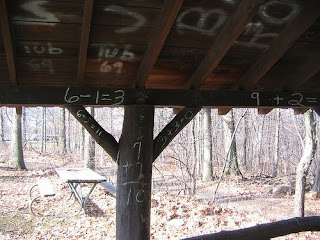
I'm finally on the other side of the Big Desk in a high school classroom, yet I still feel like somewhat of a fraud in including myself in this space for teachers. After day one out in the field, I went home more wide-eyed than when I first walked through the door that morning. But then again, it was hard to open my eyes at all in the wee hours of 7 in the morning. Some things about high school never change.
So, to be real, I'm not a teacher... maybe one day. For now, I'm still a student - a college student learning how to be a good teacher in an Oakland high school. Props to Mr. G for giving me this opportunity to rub elbows with high school students twice my stature and tenfold my own in life experiences.
Anyway, as would any decent college student, I scribbled a few notes about the students, the school day, and - aha! - the teacher, with the vague intention of stowing them away somewhere in case they come in handy one day. Again, no promises yet on the teacher thing. We'll see how the next semester goes. The following are a few lessons which I acquired by the end of my first day on the job.
Lesson #1: Anything can be said with a smile.
...and should be, for that matter. When teaching even the most difficult of concepts, it is helpful to continue the lesson as though there is nowhere else you'd rather be than standing right there in front of the class, lecturing about systems of equations. When answering questions, your delight will encourage students to keep 'em coming. When disciplining a student for their behavior, one subtle smile can let the class know that you still have control over the situation, that you have not lost your cool. Smile when they walk in the door. Smile when the seemingly never-ending class period is finally over. I'm telling you, your eager grin can work wonders. But then again, I suppose it depends on whether or not you have an attractive smile.
Lesson #2: Pay attention to the time.
Mr. G. has a stopwatch in his classroom that couldn't be worth more if it was made of its weight in gold. Sticking to your time schedule in the span of one class period will help ensure that those lost 10-15 minutes here and there every week won't avalanche and sneak up behind you at the end of the semester. Your day-to-day goals should be realistic, yet optimistic. When dealing with small margins of error, it's better to overestimate the reaches of your students than to underestimate.
Lesson #3: Teaching is kind of like juggling, walking the tight rope, and taming lions... all at once.
One kid is asleep in the corner, two are arguing in loud whispers over some pre-pubescent concern, one boy decided that his novel about Vampires is more interesting than the lecture, and only three students show any indication of keeping up with the lesson. Oh, and the telephone just started ringing. Welcome to a teacher's workday, where teaching the actual curriculum requires only about 15%* of your effort. While it may be impossible to cover all bases in the classroom, it's your job to try. In the end... well, I don't know. You may not win 'em all, but even the smallest of victories are worth a pat on the back.
I think I shall end there for now... That's not to say that in 6 hours of interacting with a hundred-some students and one teacher amounted to three measly paragraphs of a blog post. Stay tuned. I'll be back.
*Fun fact: 90% of generalizations are made up on the spot. Gotcha :)
Image Source: Nogwater under Creative Commons
Subscribe to:
Posts (Atom)